
Introduction
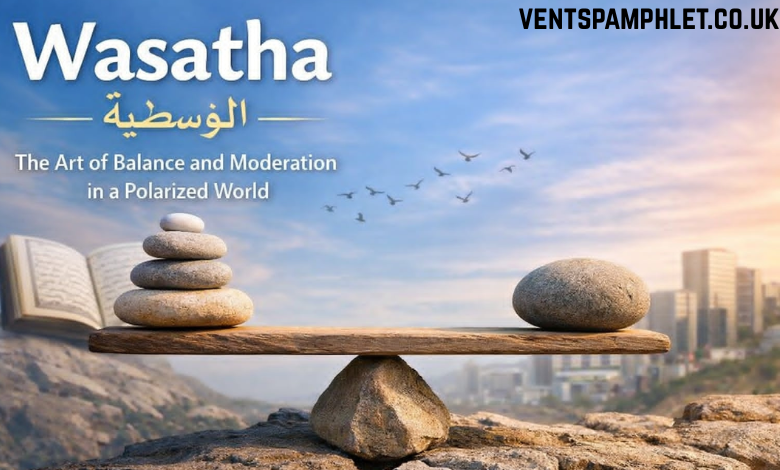
In an increasingly divided world, where extremes seem to dominate the discourse—whether in politics, culture, or everyday interactions—the concept of balance has never been more crucial. Enter Wasatha, an ancient principle that offers a refreshing antidote to the chaos of polarization. Rooted deeply in Arabic language, Islamic thought, and broader human philosophy, Wasatha represents a timeless call for balance, moderation, and fairness. This principle teaches us how to navigate life’s complexities with wisdom and harmony, finding the middle ground between opposing forces.
What is Wasatha?
At its core, Wasatha comes from the Arabic root wasat (وسط), meaning “middle,” “center,” or “between.” While this term originally referred to a simple spatial position—something equidistant from two ends—its meaning has evolved over time. It has become a powerful ethical concept that emphasizes moderation, justice, and balance in all aspects of life.
In everyday life, Wasatha encourages a mindset of moderation—steering clear of excess and deficiency in how we act, think, and make choices. It is the art of walking the middle path, not swayed by the allures of excess on either side. Rather than indulging in excess or depriving oneself, Wasatha calls for moderation in all things. It challenges us to make thoughtful, deliberate choices that lead to harmony and justice.
Wasatha in Arabic and Islamic Thought
Wasatha is deeply embedded in Islamic tradition and Arabic language, where it serves as a guiding principle for both personal conduct and societal relations. In the Quran, Wasatha is associated with the concept of being a “middle nation” or ummatan wasatan, described in Surah Al-Baqarah (2:143). This verse calls on the Muslim community to uphold moderation and fairness, promoting justice without falling into the extremes of leniency or harshness.
The Prophet Muhammad (peace be upon him) is considered the embodiment of Wasatha in his words and actions. His teachings encourage moderation in faith and practice, rejecting extremism in favor of a balanced approach. Whether it is in his personal conduct, his treatment of others, or his approach to governance, the Prophet’s life exemplifies Wasatha as a guiding principle. His example teaches that one should neither indulge in excess nor fall into neglect, but maintain balance and respect in all matters.
Wasatha in Society
Beyond individual behavior, Wasatha has profound implications for society. In a world that is often divided by ideology, politics, and cultural differences, the principle of Wasatha encourages societies to prioritize dialogue over conflict and cooperation over division. It advocates for creating spaces where people can work together, despite their differences, to achieve shared goals.
Societies rooted in Wasatha are typically those that value respect, coexistence, and mutual understanding. In such societies, the focus is not on what divides people, but on what unites them. Conflict is addressed with a spirit of fairness, aiming to find middle ground rather than creating further rifts.
For example, in political discourse, Wasatha calls for pragmatic solutions that take into account the needs of all groups within society. Instead of favoring one side, Wasatha advocates for policies that promote fairness and justice for everyone. It stresses that governance should not be about gaining power or defeating opposition, but about ensuring the well-being of all members of society.
Wasatha in the Digital Age
The rise of social media and the rapid spread of information online have amplified the voices of extremists, making it easier for divisive rhetoric to gain traction. In this digital age, where the loudest voices often dominate, Wasatha offers a grounding force. It encourages individuals to seek balance, to listen to differing viewpoints, and to engage in conversations that foster understanding rather than division.
Social media platforms, while connecting people across the globe, also tend to amplify polarization. Extreme views often receive more attention because they are more likely to provoke strong reactions. In this environment, Wasatha reminds us to approach online interactions with respect and a commitment to moderation. It calls for an active effort to counter the spread of falsehoods and to promote dialogue that prioritizes truth and understanding.
One practical way to apply Wasatha in the digital space is by cultivating good manners and promoting civil discourse. In online discussions, Wasatha encourages people to avoid inflammatory language and to approach disagreements with humility and respect. Instead of rushing to judgment or attacking others, we are encouraged to listen actively, engage thoughtfully, and seek common ground.
Wasatha in Personal Well-being
On an individual level, Wasatha promotes a balanced approach to personal well-being. In a world that often encourages excess—whether it’s materialism, food, or emotions—Wasatha calls for moderation. It teaches us to find contentment in the middle ground, neither overly indulgent nor overly ascetic.
In terms of emotional health, Wasatha encourages individuals to maintain a sense of emotional equilibrium. It advocates for patience in the face of challenges, self-control during moments of anger, and wisdom in times of distress. Instead of reacting impulsively, Wasatha encourages us to pause, reflect, and make decisions that reflect balance and fairness.
In a world where comparison to others often leads to dissatisfaction, Wasatha encourages us to focus on our own journey. It teaches the importance of gratitude and humility, helping individuals avoid the traps of envy or pride. By adopting Wasatha, we can learn to live a life that is both fulfilling and balanced, cultivating a sense of peace that comes from within.
Wasatha in Leadership and Governance
In governance and leadership, Wasatha is a principle that calls for fairness, equity, and balance. A leader who follows the path of Wasatha is one who seeks to represent all members of society, not just a select few. This approach to leadership emphasizes inclusivity and justice, ensuring that the rights of all individuals are respected.
Good governance, guided by Wasatha, is centered on policies that consider the common good and promote unity. Instead of exploiting divisions for political gain, leaders are encouraged to foster cooperation and work towards the collective well-being of society. In such a system, the voices of all groups are heard, and decisions are made with fairness and impartiality.
In practice, Wasatha in governance means making decisions that are informed by wisdom, compassion, and justice. It also means recognizing the need for balance between tradition and progress, acknowledging both the strengths of the past and the possibilities of the future.
Global Relevance of Wasatha
The concept of Wasatha is not confined to any single culture or religion. Its universal appeal makes it a valuable guiding principle for individuals and societies around the world. In a time when the world seems increasingly fragmented by conflict and division, Wasatha offers a path toward reconciliation and harmony.
On a global scale, Wasatha encourages nations to resolve conflicts peacefully, to engage in diplomatic efforts that prioritize cooperation over confrontation. It calls for international relations based on fairness and mutual respect, rejecting the logic of “us versus them” that often drives global conflicts.
Conclusion
In a world characterized by extremes, Wasatha offers a powerful message of balance, moderation, and justice. It calls us to rise above the divisions that often dominate our personal lives, communities, and societies. By embracing Wasatha, we can build a more thoughtful, peaceful, and compassionate world—one where harmony replaces conflict and dialogue replaces division.
Whether in our personal choices, our interactions with others, or our engagement in global issues, Wasatha provides a timeless framework for living wisely and justly. In a polarized world, the principle of Wasatha is more relevant than ever, offering a path to peace, understanding, and mutual respect. By embodying Wasatha, we can contribute to a more balanced and harmonious world for future generations.
FAQS
1. What does Wasatha mean?
Wasatha is an Arabic concept that represents balance, moderation, and fairness, encouraging a middle path in all aspects of life.
2. How does Wasatha apply to modern society?
In today’s polarized world, Wasatha offers a balanced approach to conflict resolution, tolerance, and respectful dialogue.
3. Is Wasatha only relevant in Islamic philosophy?
No, Wasatha is a universal concept that emphasizes balance and moderation, applicable across different cultures and philosophies.
4. Can Wasatha help improve personal well-being?
Yes, Wasatha promotes emotional equilibrium and a balanced lifestyle, encouraging moderation and thoughtful decision-making for personal peace.
5. How can societies benefit from Wasatha?
By embracing Wasatha, societies can foster tolerance, reduce polarization, and create a more just, fair, and peaceful environment.